Your shoulder has been tight since the summer. You have tried the heat. You have tried the stretches, and the massage that helped for two days.
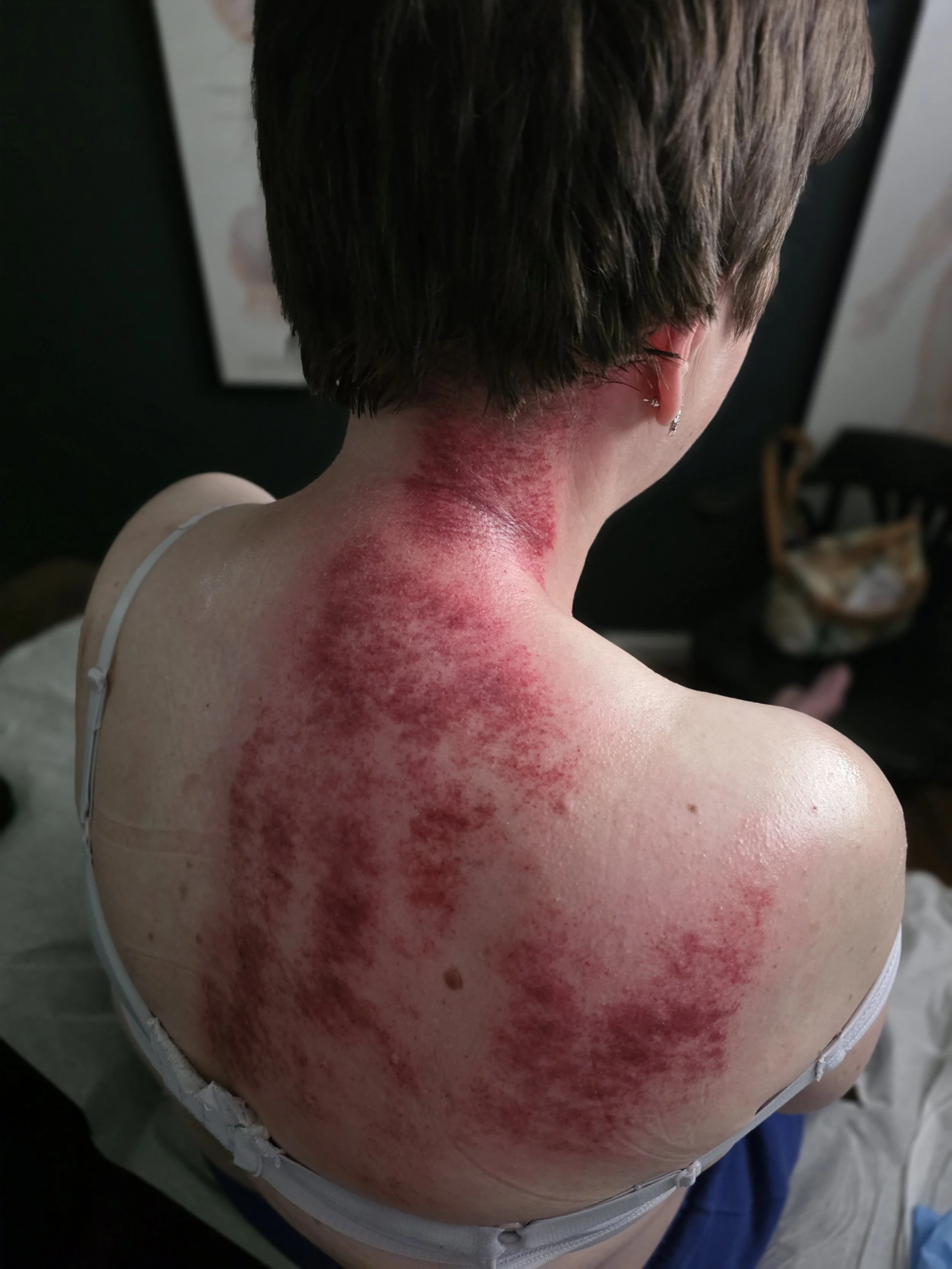
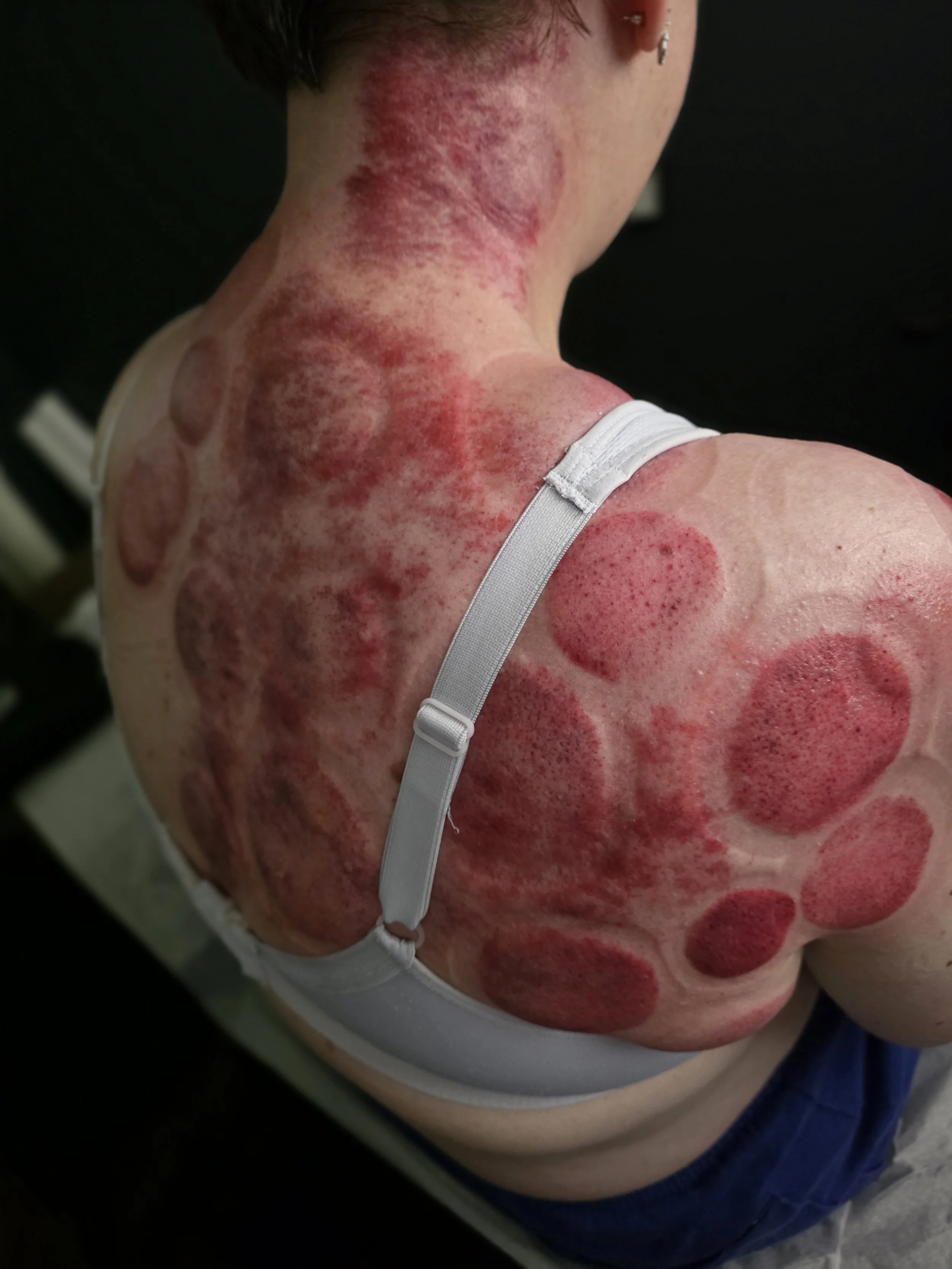
Somewhere along the way you saw the photographs. Round purple circles down somebody's back, or long red stripes across their shoulders.
And the question you actually have isn't whether it works. It's whether that's going to happen to you, whether it hurts, and whether you can go to work Monday looking like that.
Those are fair questions and they go first. Then I want to tell you something more useful, which is that those two sets of marks come from two different tools doing two different jobs on the same sore neck.
They aren't bruises
A bruise is bleeding under the skin because something struck you. A vessel tore. That's an injury, and it stays sore to the touch for days.
What you're looking at in those photographs isn't that. Nothing hit the person.
Under a cup, the skin and the tissue beneath it get drawn upward by suction. Under gua sha, a smooth-edged tool travels along oiled skin. Either way the contents of the smallest surface vessels come up toward the skin, where you can see them. No blow. Nothing torn. Drawn to the surface rather than crushed into it.
That's also why the two feel different. Pressing a bruise hurts. Pressing one of these can be more comfortable than the shoulder was before anybody touched it.
How dark the color goes depends on the person and on how much there was to bring up. The arc is the same either way: the color arrives inside the hour, it holds, and then it clears from the edges in. How long that takes has its own section below, because it's what most of you came here to find out.
And if you have a wedding on Saturday, tell me on the way in. We work somewhere a collar covers, or we use something else.
The names tell you what the tradition cared about
A short detour, because the two names aren't built the same way.
Cupping in Chinese is 拔罐, ba guan. Pulling jar. The technique is named after the vessel, and before there was glass the vessels were bamboo and animal horn.
Gua sha is 刮痧. Gua is to scrape. Sha is the mark itself. So one tool is named for the thing you hold, and the other is named for the thing that comes up. That tells you where the attention was. Sha became a category of its own in this medicine, a family of presentations that got written up formally in the Ming, and the mark was being read as information for centuries before anybody thought to photograph it.
I'm naming no text and no chapter here. I haven't checked them this week, and a citation I haven't checked is worse than none at all.
The color is information, not a result
Here's the part I'd want to know if I were you, and it's why I photograph this in the clinic at all.
What comes up tells me about the tissue I just worked on. One side of a neck coming up dark while the other side stays pale is a finding. It says the two sides are not in the same condition, which is something you already suspected and nobody had shown you.
And the reverse is a finding too, which is why I look at the side that isn't complaining.
Clinical experience says there's a good chance the quiet side is in much the same condition as the sore one, and that you have no idea. It isn't every case. But it happens enough that I'd rather check than assume, and this is one of the few things in medicine where checking costs nothing: work both sides, and the picture is right there in front of you. The side you came in about isn't always the worse of the two.
What it is not is evidence that anybody got better. I want to be plain about that, because the internet is full of the other claim. A darker mark is not a better outcome. It isn't waste leaving your body. It's the surface of your shoulder reporting on itself, and the value of it is that it tells me where to work next time.
How long the marks last
This is the question that brings people to a page like this one, so here it is before the rest.
Gua sha marks go first. A light stripe can be gone in a couple of days.
A cup mark is a different proposition, and a deep, dark purple one is different again. In my own clinic I'd tell you that some level of visibility can stay for upwards of three or four weeks. Not sore. Just still faintly there.
What moves that number is how deep it went, how much came up, where it sits on you, and how well supplied that patch of you happens to be.
And I'm not going to give you one figure and promise it, for a reason worth knowing. Forensic medicine has spent decades trying to date a bruise from its color, because being able to would matter in a courtroom. A review of that whole literature found one thing you can read with any confidence: yellow, not orange or brown, means the mark is not recent. It also says plainly that it isn't known how the wide range of factors influencing how a mark forms and clears affect any estimate of its age.
If the people with a professional reason to pin it down won't, I'm not going to either. What I'll tell you is the direction: it fades from the edges inward, and then it's gone.
One tool presses and travels. The other lifts and stays.
Both of these work at the surface. That's where the resemblance ends.
Gua sha is an edge. A smooth-edged tool, a little oil, and strokes that run in one direction along a band of muscle. It covers ground. The stripe of upper back that's tight from the base of your skull out to the point of your shoulder is ground, and the tool goes over all of it.
Cupping is suction, and suction pulls upward. The cup sits in one place and lifts the tissue into itself instead of pressing it down. Think of it like a reverse deep-tissue massage.
So the choice between them was never about which one is stronger. It's about whether your problem is a territory or an address.
How I pick, on a real shoulder
A band that's tight from the neck out to the shoulder, on both sides, and worse by Thursday than it was on Monday: that's a territory. The tool that travels suits it, because the problem has no single home to visit.
One spot you can put a finger on, that's been worked on repeatedly, that softens and comes back to the same square inch: that's an address. The tool that stays and lifts has somewhere to be.
A spot with an address tells me something else too, and it's the more interesting half. It tells me where the branch is. It doesn't tell me what keeps putting it there.
There are clues before I pick anything up, and I'd rather have them than not. The band reads cool to the back of my hand while the skin either side of it doesn't. You tell me it stiffens in cold weather, or that it's worst in the morning before you've moved around. The tissue feels dense rather than simply tight, which is a different thing under a hand. And the ordinary work has been done on it and the shoulder still hasn't finished.
And I don't commit a whole back to a guess. I'll test a small patch first, a few passes with the tool in one place, and then look.
If sha comes up in those few passes, it tells me there's a larger area underneath that wants covering, and we go and finish it properly. If nothing comes up, I've learned something too, and I haven't spent your appointment on the wrong tool.
Sometimes a presentation wants both tools, not one. In that case gua sha goes first and cupping follows, and the order isn't arbitrary: the tool that travels covers the ground and shows me where the sha actually is, and then the tool that lifts has somewhere to go. Territory first, then the addresses the territory turned up.
That distinction is old. 標 and 本, biao and ben, branch and root, set out in the Su Wen's sixty-fifth chapter. The branch is what you came in about. The root is the reason your body hasn't finished the job on its own. A shoulder that's had good work done on it and keeps returning is telling me the branch is being treated well and something upstream is resetting it.
Which is why neither of these tools is ever the whole appointment. It's also the layer underneath a piece I wrote this month comparing four different ways of treating one stiff neck. That one asks what each tool does. This one asks what has to be true about your shoulder before I pick one up.
When I don't reach for either
This is the part that makes the rest of it believable, so I'm not going to skip it.
Skin that's thin or fragile. Anybody on a blood thinner or an antiplatelet, anybody with a low platelet count, anybody who's been on steroids a long while. Over a fresh injury, a suspected fracture, a mole, a rash, broken skin, an infection, or a vein that's already standing up.
And one that has nothing to do with safety: somebody who is going to spend the week looking in the mirror and feeling worse about themselves. That costs more than the treatment gains.
Then there's the honest one. Sometimes a thumb is enough. I wrote that out too, because if pressing a spot for a minute gives you your week back, you don't need me, a cup or a scraper, and saying so costs me an appointment I'd rather not have taken.
Some things on a neck belong with a physician before they belong with me. A headache unlike any you've had before. Fever with a stiff neck. Pins and needles running down an arm, or weakness in the hand. Anything that started with a fall, a crash or a blow. A change in your speech or your vision. Those are physician questions and they come first.
A word about the thing in the skincare aisle
The flat stone being sold for faces is from the same family, and it's doing a different job: lighter pressure, cosmetic intent, and a very different piece of anatomy. Nothing wrong with it.
What I've described here is the clinical use, over a back and a shoulder, where the point is to cover ground, bring something up, and read what comes. Same word, different work.
What a page can't do
A page can tell you how two tools differ. It can't tell you which one your shoulder wants, because that takes somebody with a hand on it.
That's the half of this that doesn't fit in writing. Where the tissue gives and where it refuses. What the skin does when it's drawn up, and how fast the color goes again. Whether the shoulder is the injury, or the place the strain ended up.
Near Williamsport or Lewisburg, or out in the county? Then that can be me. Here's what a first visit actually looks like, and the page on neck and shoulder pain is there if you want to read before you decide anything. Book whenever you're ready, or call the clinic at (570) 322-6824 if you'd rather ask something first.
best all ways always
This is general education, not medical advice. It is not a diagnosis and it is not a treatment plan for you. Talk to your own healthcare provider about your own situation.
Dr. Jeremy E.R. Reidy, BS, MSOM, AP, DOM is a Licensed Practitioner of Oriental Medicine in Pennsylvania and a licensed Acupuncture Physician and Doctor of Oriental Medicine in Florida. He practices in Williamsport and Lewisburg, treating the whole presentation rather than the complaint somebody walked in with, and reading blood chemistry alongside the tongue and the pulse.
Want more of this? The Regulation Brief is a weekly letter on what your body has been trying to tell you, written the way it gets explained in the treatment room. Subscribe at theregulationbrief.substack.com