What Acupuncture Actually Does While You Rest
Most people come in thinking the needles are the treatment.
They're not.
The needles are the invitation. What happens in the hour that follows — that's the treatment. And for the last 20 years, I've been watching it happen from the other side of the room.
Here's what I know — and what the research confirms.
The First Five Minutes
Within five minutes of needle insertion, something measurable begins.
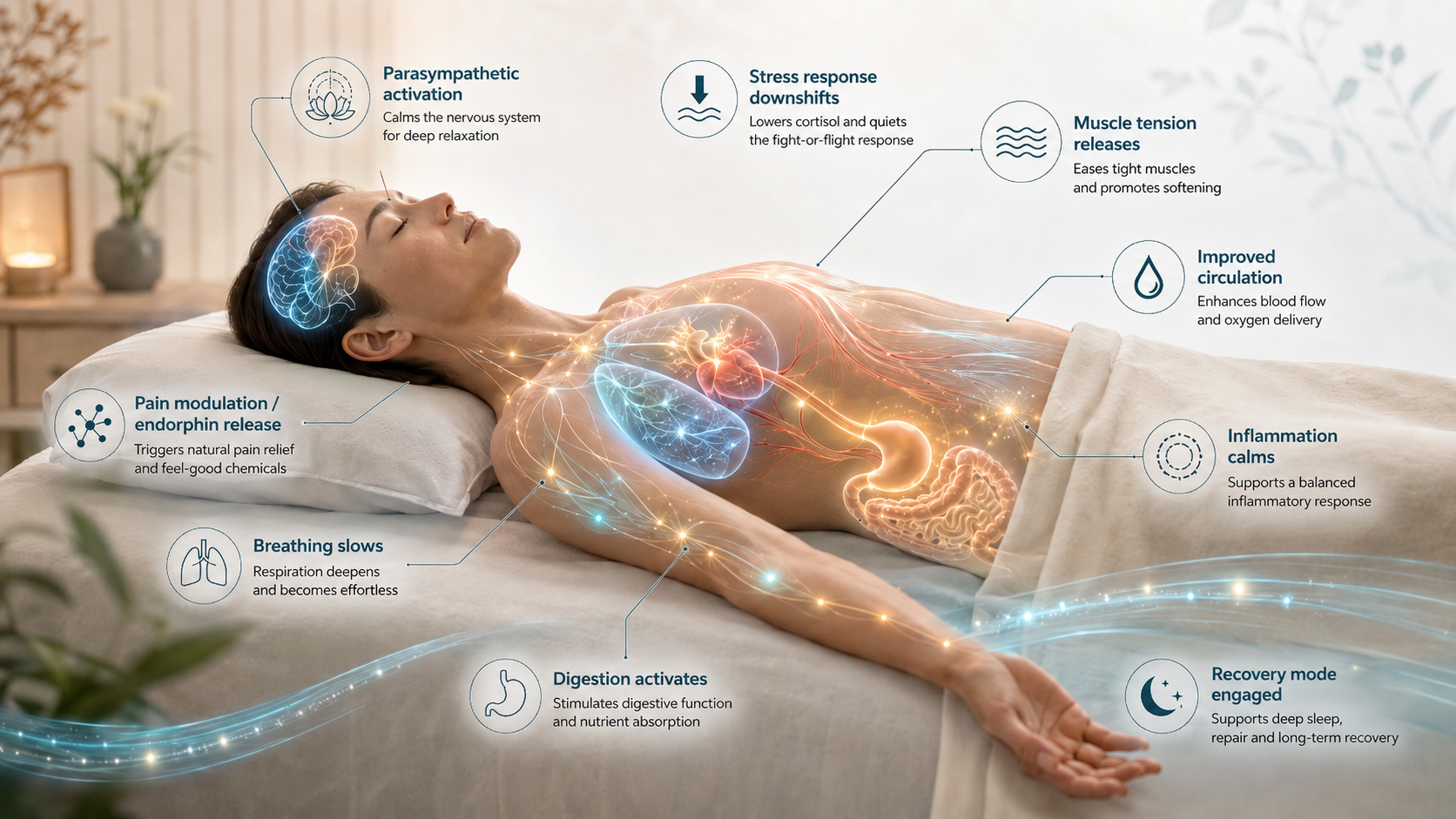
Heart rate slows. Not dramatically, not dangerously — just a quiet, measurable decrease. Heart rate variability shifts. The autonomic nervous system, which operates entirely without your conscious input, begins moving away from sympathetic dominance — the fight-or-flight state most people live in constantly — and toward parasympathetic activity. Rest. Digest. Repair.
This isn't theory. It's been documented in human clinical trials and confirmed in multiple systematic reviews. A 2022 meta-analysis concluded that real acupuncture produces superior parasympathetic activation compared to placebo acupuncture, measurable through heart rate variability markers including increased vagal tone and decreased sympathetic activity.
The shift begins within five minutes. It persists beyond the session.
What the Body Releases
While you're lying there — possibly already drifting — your body is working.
Beta-endorphins release from the central nervous system. These are the body's natural painkillers, and their release during acupuncture has been directly measured in human cerebrospinal fluid. This is one of the most replicated findings in acupuncture research.
Nitric oxide increases at needle sites within minutes of insertion. Nitric oxide is a potent vasodilator — it causes blood vessels to open. This is the mechanism behind the warmth and redness you sometimes see or feel around a needle site. Tissues that haven't been well-circulated in years begin receiving what they need.
GABA — the nervous system's primary calming signal — increases. GABA is the same neurotransmitter targeted by anti-anxiety medications. When it rises, the nervous system quiets. Which is why most people fall asleep.
Serotonin activity increases in brain reward pathways, which is one proposed mechanism for acupuncture's effects on mood and emotional regulation.
Adenosine releases at the acupoint level, acting as a local analgesic — the body's own numbing mechanism, activated by the needle.
The Acu-Nap Is the Mechanism
Most patients apologize for falling asleep.
There's nothing to apologize for.
Sleep isn't a side effect of acupuncture. It's evidence that the treatment is working. When the nervous system truly releases — not just slows down, but hands over control — the body's self-repair mechanisms can operate without interference.
Oxygen circulates. Nutrients reach tissue. Inflammatory signals quiet down. The HPA axis — the body's stress-response system — begins to modulate. The body does, in 45 minutes on a table, what it's been trying to do for months.
The HPA axis — the body's stress-response system — begins to modulate. Cortisol, the primary stress hormone, decreases. The body stops borrowing against tomorrow to get through today.
The depth of rest is the depth of repair. They are the same thing.
What I See From My Side of the Room
The needles are also telling me something.
Redness around an insertion site means blood is moving to that point — the body sending resources. When someone is blood-deficient, it happens quickly. When someone is tight and constricted, it happens slowly, as the tissue relaxes and circulation returns.
A white ring around that redness tells me cold is present in the tissue — stagnation, poor circulation, Yang deficiency in TCM terms.
A raised red bump means excess heat is present — the body pushing back against the needle.
Pitting around the needle means the tissue is fluid-depleted — the body pulling the needle in, hungry for what the point offers.
By the time I come back into the room, the needle sites have been reporting to me for an hour. I don't need to ask how the treatment went. The skin already told me.
What Patients Experience
Some patients feel deeply relaxed and calm but remain aware throughout.
Others sleep. Genuinely, deeply sleep — the kind of rest that leaves them needing a moment to return to the room when I come back in.
And some — those who go deepest — begin to see.
Colors move across the visual field behind closed eyes. Images arrive. Animals, scenes, occasionally figures that carry personal or spiritual significance. Patients describe these experiences quietly, sometimes almost embarrassed, as if they shouldn't have happened.
One patient described it this way: "A kaleidoscope of colors — yellow first, then green, then a bright electric blue — and finally the most beautiful purples and indigos I've ever seen. After that, I can't remember a thing. I woke myself up snoring and went right back to sleep. It was unlike anything I've ever experienced in my life."
They happened because the analytical mind finally stepped back.
When the nervous system releases its grip, the part of you that narrates and categorizes and manages goes quiet. What remains is something older — the body's own symbolic language. It speaks in sensation and image because it has no other way to communicate.
There is no dialog between the mind and the man.
There are only the things the body knows that language doesn't reach.
Why This Matters for Your Health
The research on what acupuncture does is increasingly clear. The parasympathetic shift is measurable and consistent. The neurochemical changes are real. The clinical outcomes — improved sleep, reduced pain, better mood regulation, clearer digestion — follow logically from a system that has been given the conditions to function correctly.
Most people live in chronic sympathetic overdrive. The fight-or-flight system was designed for acute threats, not 60-hour work weeks and phones that never turn off. When that system runs continuously, repair stops. Circulation suffers. Sleep quality drops. Pain thresholds lower.
Acupuncture doesn't add anything to the body.
It creates the conditions for the body to do what it already knows how to do.
Your nervous system has a gear it rarely gets to use. The table is where we shift into it.
Dr. Jeremy Reidy is a Doctor of Oriental Medicine and licensed acupuncturist at the Reidy Center for Integrative Medicine in Williamsport, PA. He has been in clinical practice for over 20 years.
Schedule a consultation: acupuncture.blue
Substack: theregulationbrief.substack.com